
Implement three types of voice-enabled AI applications: a voice-interactive game, a voice-layered agent, and an agent that places outbound phone calls.

Short CourseBeginner1h26m
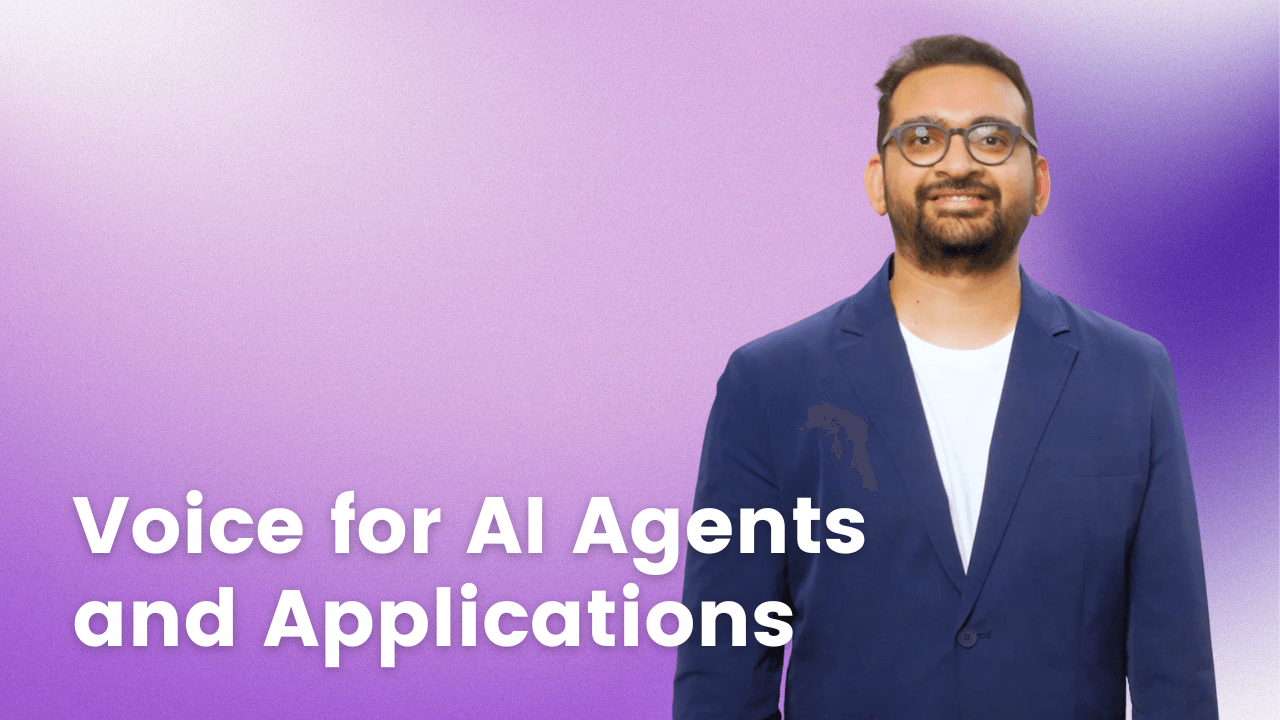
Voice for AI Agents and Applications
Instructor: Ashwyn Sharma

Earn an accomplishment with PRO
- Beginner
- 1h26m
- 8 Video Lessons
- 5 Code Examples
- 1 Graded Assignment PRO
- Earn an accomplishment with PRO
- Instructor: Ashwyn Sharma
 Vocal Bridge
- Learn more aboutMembership PRO Plan
VocalBridge 7-Day Challenge
Put your voice-AI skills to the test in a 7-day build challenge. Join the waitlist to be notified when it opens.
Join the waitlistWhat you'll learn
Add voice to an existing agent with minimal code, without rewriting your prompts, RAG pipeline, or tools.
Use voice evaluation to score your agent's calls, surface failure modes, and improve quality before reaching production.
About this course
Voice is one of the most natural human interfaces, but adding it to AI applications has historically forced a tradeoff: fast voice-to-voice models that sacrifice reliability, or accurate speech-to-text-to-LLM-to-speech pipelines that add latency.
This course teaches you how to get both, using Vocal Bridge's architecture that pairs a real-time foreground agent with a reasoning background agent.
Taught by Ashwyn Sharma, CEO and Co-Founder of Vocal Bridge (an AI Fund portfolio company), this course covers three practical integration patterns that meet you where you are: voice embedded in an application, voice layered onto an existing agent without touching its logic, and voice as a tool your LLM can call when it decides a conversation is the right modality.
In detail, you'll:
- Survey the traditional voice stack and its tradeoffs, then explore three live integration patterns to understand when each one applies.
- Build a voice-interactive tic-tac-toe game where voice commands and mouse clicks work together over a single synchronized channel, then add a voice layer to an existing agent with minimal code, leaving your prompts, RAG pipeline, and tools untouched.
- Give your agent a make_phone_call tool so it can dial a real number, hold a conversation with a demo agent, and stream the transcript back live.
- Set up evaluation-driven development using Vocal Bridge's multimodal evaluator to score calls, catch regressions, and refine prompts before issues reach users.
- Hear from Scott Johnston, former CEO of Docker and Vocal Bridge board member, on what it actually takes to move voice agents from demos to production.
By the end of this course, you’ll have implemented three hands-on voice AI patterns: adding voice to an interactive app, layering voice onto a text-based agent, and giving an agent the ability to place outbound calls. You’ll also know how to evaluate and improve voice interactions.
Who should join?
Developers and AI builders who want to add voice to their agents or applications. Basic familiarity with Python is recommended. No prior experience with voice APIs is required.
Course Outline
8 Lessons・5 Code Examples- IntroductionVideo・4m
- Overview of Voice UIVideo・9m
- Voice in Your AppVideo with Code Example・10m
- Voice for Your AgentVideo with Code Example・12m
- Voice as a ToolVideo with Code Example・9m
- Voice AI EvalsVideo with Code Example・10m
- Voice Agents in ProductionVideo・8m
- ConclusionVideo・1m
- GlossaryReading・10m
- (Optional) Create a Vocal Bridge AccountCode Example・1m
- Quiz
Graded・Quiz
・10m
Elevate your learning experience with Pro
Upgrade to Pro and gain unlimited accomplishments on your resume
Instructor

Additional learning features, such as quizzes and projects, are included with DeepLearning.AI Pro. Explore it today
Want to learn more about AI?
Keep learning with updates on curated AI news, courses, and events, as well as Andrew Ng’s thoughts from DeepLearning.AI!