
Build LLM applications that respond in real time, like live personalization and a multi-tool workflow that runs several steps in one fast response.

Short CourseIntermediate1h42m
Fast LLM Inference with Cerebras
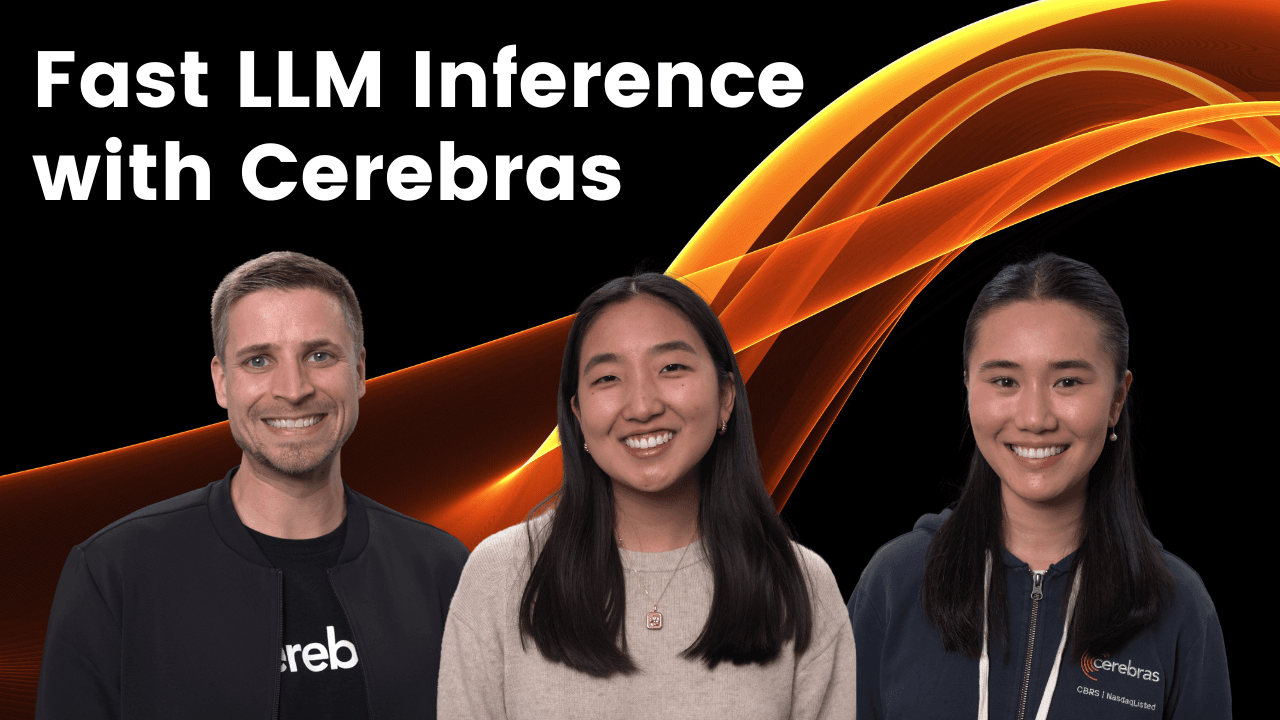
Instructors: Zhenwei Gao, Sebastian Duerr, Sarah Chieng

Earn an accomplishment with PRO
- Intermediate
- 1h42m
- 10 Video Lessons
- 4 Code Examples
- 1 Graded Assignment PRO
- Earn an accomplishment with PRO
- Instructors: Zhenwei Gao, Sebastian Duerr, Sarah Chieng
 Cerebras
- Learn more aboutMembership PRO Plan
What you'll learn
Explore what actually makes inference slow: the time spent moving a model's weights from memory to the compute units.
Write simpler application, calling the model directly instead of building workarounds to hide slow responses.
About this course
When a language model generates text, much of the time goes to moving the model's weights from memory to the compute units. Inference-optimized hardware keeps those weights close to compute, generating tokens several times faster than a typical GPU setup. That speed changes both what you can build and how you build it.
This course, built in partnership with Cerebras and taught by Zhenwei Gao, Sebastian Duerr, and Sarah Chieng of Cerebras, shows you how to build LLM applications that respond in real time on Cerebras' Wafer-Scale Engine (WSE-3). It's a chip large enough to hold a model's weights on-chip, right next to the compute units. You'll run fast inference and see where that speed matters most: latency-sensitive use cases like live personalization and real-time multi-tool workflows.
Fast inference also simplifies your code. When the model responds before a user really notices, you can drop the workarounds built to hide slow responses, like loading spinners or streaming text out a few words at a time, and just call the model directly. You'll see the same shift reshape agentic coding: validating between steps instead of at the end, so you catch issues early and produce cleaner code.
In detail, you'll:
- Examine how inference speeds have evolved across hardware generations, then run fast inference to experience how it transforms application design.
- Compare how GPUs, TPUs, and Cerebras' Wafer-Scale Engine handle the memory-to-compute bottleneck, and why keeping weights on-chip minimizes data movement.
- Rethink how you design applications around fast inference, calling the model directly instead of engineering around slow responses.
- Build a real-time personalization use case that adapts a webpage to users as they interact with it.
- Assemble a real-time, multi-tool workflow that runs live analysis of market signals in one fast response.
- Adopt concrete habits for multi-agent coding with Codex, validating between tasks to catch issues early and ship cleaner code.
By the end, you'll know how to build the kind of responsive, latency-sensitive applications that fast inference makes possible.
Who should join?
This course is for developers and AI engineers who want to build faster, more responsive LLM applications and agentic systems. Basic familiarity with Python and calling an LLM API will help you get the most out of the hands-on labs.
Course Outline
10 Lessons・4 Code Examples- IntroductionVideo・4m
- The New Era Of Inference SpeedVideo・7m
- Inference Speed in Action - Part IVideo・4m
- Inference Speed in Action – Part IIVideo with Code Example・9m
- Under the Hood of WSE vs GPU vs TPUVideo・11m
- Engineering ShiftsVideo with Code Example・13m
- Real-Time Use Case on PersonalizationVideo with Code Example・10m
- Real-Time Multi-Tool WorkflowVideo with Code Example・13m
- Multi-Agent Coding with CodexVideo・5m
- ConclusionVideo・1m
- Quiz
Graded・Quiz
・10m - Glossary (Optional)Reading・10m

Elevate your learning experience with Pro
Upgrade to Pro and gain unlimited accomplishments on your resume
Instructors




Additional learning features, such as quizzes and projects, are included with DeepLearning.AI Pro. Explore it today
Want to learn more about AI?
Keep learning with updates on curated AI news, courses, and events, as well as Andrew Ng’s thoughts from DeepLearning.AI!